SAP-Embedded Virtual Cards FAQs
The One Essential Resource for Issuers & Customer-Facing Teams
Introduction to This Guide
The following guide will help you address client questions about virtual cards, including SAP’s own embedded virtual card capability.
You’ll learn about the general benefits of virtual cards for buyers and suppliers and how they compare to other payment methods. In addition, you’ll discover more about SAP Taulia’s own virtual card capability — from broad-stroke benefits to implementation details.
One Capability. Two Ways to Pay.
SAP-embedded virtual cards flexes to two different payment options: Pay on Invoice and Pay on PO. This guide features distinct FAQ sections for both to help you understand how they work and their ideal customer profile.
If you have a question that isn’t addressed, please review the additional resources at the end of this guide or contact your organization’s SAP Taulia representative.
1. General Introduction to Virtual Cards
Typically, companies add virtual cards to their mix of payables because they:
- Streamline administration: Virtual cards reduce manual and repetitive payment processes and often consolidate high-frequency, low-value transactions that exacerbate inefficiency during month-end reconciliation.
- Offer robust payment security: 79% of organizations reported they were victims of attempted or actual payment fraud in 2024 (according to an Association of Payment Professionals survey). Virtual cards make fraud much less likely with built-in payment controls.
- Often provide financial incentives: Companies that use virtual cards receive agreed-upon rebates brokered through their bank issuer that help to reduce the cost of goods and services.
- Extend days payable outstanding (DPO): Similar to the credit cards we use daily, companies can hold onto their cash for longer when they acquire supplier goods and services with the credit offered through virtual cards.
Suppliers worldwide enjoy the following features generally applicable to virtual card payments:
- Convenience: Because payments are digital, suppliers (especially in the U.S.) don’t have to wait for snail mail: Payments are easily accessible online.
- Payment certainty: Half of the suppliers that responded to SAP Taulia’s most recent survey reported getting paid late. Most virtual card solutions streamline issuance (SAP Taulia’s does so with automation), so payments arrive on time.
- Payment security: Virtual cards are generally considered the most secure payment method on the market.
- Ease of reconciliation: Virtual card solutions often include remittance details with the payment information that can be used for reconciliation (as ours does).
| Method | Security | Transfer speed | Cost | Cash benefit |
|---|---|---|---|---|
| Virtual cards | High. Only partial accounts are exposed by email; charge once, and the exact amount is required. | Fast. Funds are available upon charging, depending on the agreement with the acquirer. | Low. Free for the buyer, though an interchange fee is charged to suppliers. | High. The buyer can hold cash for up to 30 additional days and may qualify for a rebate. |
| Physical cards | Low. Unauthorized and overcharges occur; the account may not be securely stored. | Fast. Funds are available upon charging, depending on the agreement with the acquirer. | Low. Free for the buyer, though an interchange fee is charged to suppliers. | High. The buyer can hold cash for up to 30 additional days and may qualify for a rebate. |
| ACH | Moderate. Supplier bank account information is required for setup. | Moderate. It typically takes up to three business days to complete. | Low. Negligible transaction fees apply, but some administrative overhead is required. | Low. Little-to-no working capital benefits due to processing time. |

2. SAP Taulia ERP-Embedded Virtual Cards
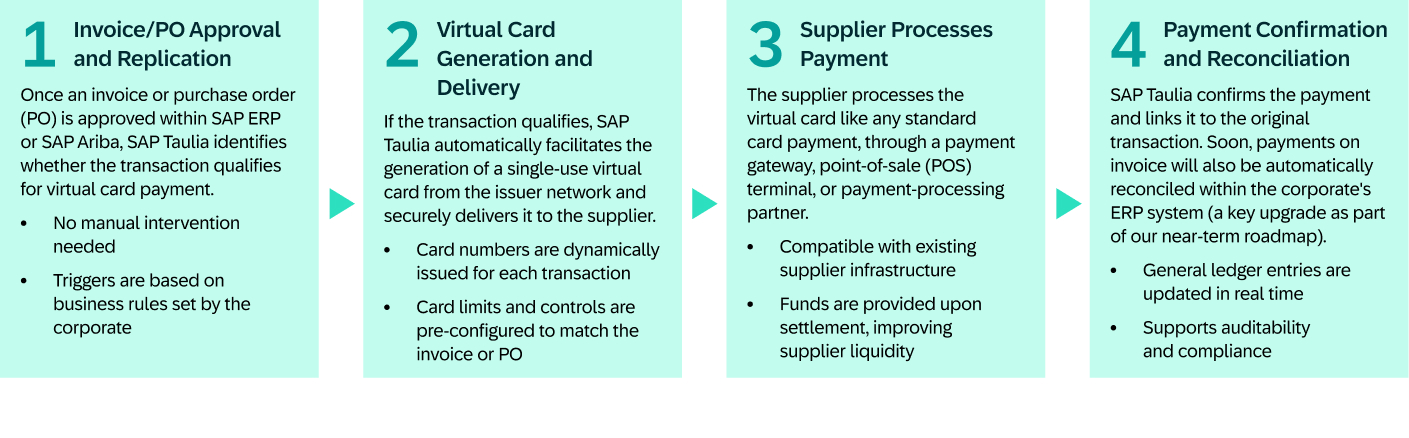
SAP Taulia ERP-Embedded Virtual Cards (or ‘Pay-on-Invoice embedded cards’) are, as the name suggests, our Pay on Invoice solution. Clients can use it to automatically pay high-volume, invoice-based suppliers from within their existing SAP ERP systems.
Pay-on-Invoice embedded cards offer many of the same features as other virtual card solutions. These include the most robust security features among payment methods to protect against fraud; rapid transmission of a unique, randomized virtual card number (VCN); easy access to remittance details for suppliers; and a working capital benefit for buyers who don’t have to repay a charged amount immediately.
In addition to these core features, Pay-on-Invoice embedded cards function as a configurable or native payment in your customers’ SAP ERP systems. Thanks to a configurable API integration, it automates ERP entries and general ledger movements throughout the transaction lifecycle. This includes users of SAP ECC (6.0+), SAP S/4HANA (on-premise and Cloud editions), and the SAP Business Network. Administering Pay-on-Invoice embedded cards from SAP Taulia also requires minimal manual effort, creating lasting operational efficiencies for back-office staff.
There are three distinct points of difference:
- Increased supplier acceptance: SAP Taulia’s supplier intelligence engine identifies more suppliers and cardable spend, leading to 2–3x higher supplier acceptance than the industry average.
- Reduced operational expense: With Pay-on-Invoice embedded cards, reconciliation functionality enables a seamless sync with a corporate’s ERP system. This can save 1,000-3,000 hours a year in manual effort, leading to a potential $150K-$300K ROI in 12 months (based on a $200M sized program).1
- Lowered IT expense: Plug-and-play issuing removes the need for complex bank integrations, which can save organizations $100K-$300K in IT costs.
1 Full functionality of SAP Taulia’s automated statement reconciliation feature won’t be available until 2026.
SAP Taulia ERP-embedded virtual cards’s are integral to working capital management within an organization’s payables. Generally, solutions like supply chain finance cover the short tail, while mid-to-long-tail suppliers could accept company-funded early payments (i.e. dynamic discounting).
However, other suppliers — especially those with high-frequency, low-value transactions — tend to be overlooked, despite the fact that buyers could benefit from the natural release of working capital inherent in credit-based payments.
Two main components are required in the program deployment and activation of Pay-on-Invoice embedded cards:
- A typical onboarding program takes approximately 16 weeks from contract signature to full go-live and post-launch support.
- The buyer must also establish a new credit card program, the completion of which is dependent on your institution’s credit and risk management processes.
Ideally, portions of these two workstreams should be completed concurrently to optimize the customer’s time-to-value.
| Attribute | Ideal | Acceptable |
|---|---|---|
| Company type | Operates business with an SAP ECC (version 6.0 or greater) or SAP S/4HANA (on-premise or Cloud edition) ERP system. | Not applicable |
| Revenue / spend | • +$2.5B <
• +$50M cardable spend (or roughly 2% of total spend) |
Between $750M – $2.5B in annual revenue but more than $20M in cardable spend could still make a viable candidate |
| Industry | Product-based industries that rely on the supply chain (pharmaceutical, retail, manufacturing, automotive, food & beverage, logistics, etc.) are the best and most ideal fits | Service-based industries like consulting, software, or information technology are poorer and less ideal fits |
3. Embedded Virtual Cards in SAP Ariba Buying
Embedded virtual cards in SAP Ariba Buying (or ‘Pay-on-PO embedded cards’) is our Pay on PO solution. Clients can use it to issue compliant, secure payments to ad-hoc vendors and more from inside SAP Ariba Buying.
SAP’s Pay-on-PO embedded cards are a new payment capability within SAP Ariba Buying / Buying and Invoicing. Clients use Pay-on-PO embedded cards to pay suppliers on Purchase Orders (POs), leveraging SAP Taulia’s virtual card payment processing and supplier adoption expertise on the back end. The solution maintains a unified Ariba Buying user experience and SAP-branded service design.
- Efficient supplier management: Ad-hoc suppliers can be issued virtual cards compliantly without workarounds or being added to the vendor master record. On average, this efficiency gain can save clients $500-700 per supplier.
- Working capital optimization: Clients can strategically extend payment terms using commercial credit to pay suppliers.
- Streamlined payments: Pay-on-PO embedded cards reduce manual effort by automating payments, offering clients an integrated payment experience within the familiar Ariba Buying workflow.
- Improved supplier collaboration: Payment on PO ensures suppliers have the funds to deliver contracted goods and services quickly.
- Reduced fraud risk: Pay-on-PO embedded cards offer enhanced security compared to checks or physical cards.
Regardless of whether they have an existing or new virtual card program, corporates will need your institution to supply a credit line for use in embedded virtual cards. A combined SAP Ariba and Taulia team will primarily complete this collaborative work with you and configure the solution for onboarding.
The embedded virtual cards feature is not designed to pay invoices through SAP Ariba Buying / Buying and Invoicing. However, another iteration of the offering (SAP Taulia ERP-Embedded Virtual Cards) is available for issuance from SAP ERP systems and is designed to pay supplier invoices.
First, clients must work with you to initiate a new real card for virtual use. Then, an SAP card specialist will acquire the account details from your institution and finalize the embedded virtual cards configuration. This process, which includes establishing a new line of credit, may take a few weeks to complete — although the configuration itself takes up to two business days to complete.
While far from an exhaustive list, here are three clear indicators that an organization is an ideal embedded virtual card customer:
- They’re dedicating significant spend towards paying ad-hoc suppliers — and potentially facing challenges when they do so.
- They’re having trouble addressing needs for urgent spend.
- They lack control and visibility (i.e. compliance) for major swaths of spend.
4. Go One Step Further: Learn More with Our Dedicated Resources
The information above covers some of the most important topics related to virtual cards. But if you want to find out more, we’ve created the following resources:
If there’s anything else you’d like to know about SAP’s embedded virtual card capability, get in touch with our team: [email protected]