
Blog
Expert Advice
8 min read
27 Oct 2026

Blog
Expert Advice
8 min read
27 Oct 2026
Treasury works best when cash, risk, and operational data are connected. When treasury software and ERP software are siloed, teams lose productivity to reconciliation, delayed information, and manual transfers. That makes it harder to act quickly and confidently on cash and liquidity decisions.
If your company already runs SAP ERP, there are three specific areas to pay attention to: how the treasury management system integrates with your ERP and core financial data, how well it helps you visualize cash and take action, and whether its AI features are reliable and make sense in your business context.
Even if you do not have SAP across your entire ERP estate, you can easily take advantage of SAP’s comprehensive treasury capabilities connected to your other ERPs creating a central payment and cash center with company-wide risk management.
In summary, there are three main reasons for treasury teams to choose SAP as their treasury management system:
SAP was named a Leader in the
IDC MarketScape: Worldwide AI-Enabled Enterprise Treasury and Risk Management Applications 2025–2026 Vendor Assessment.
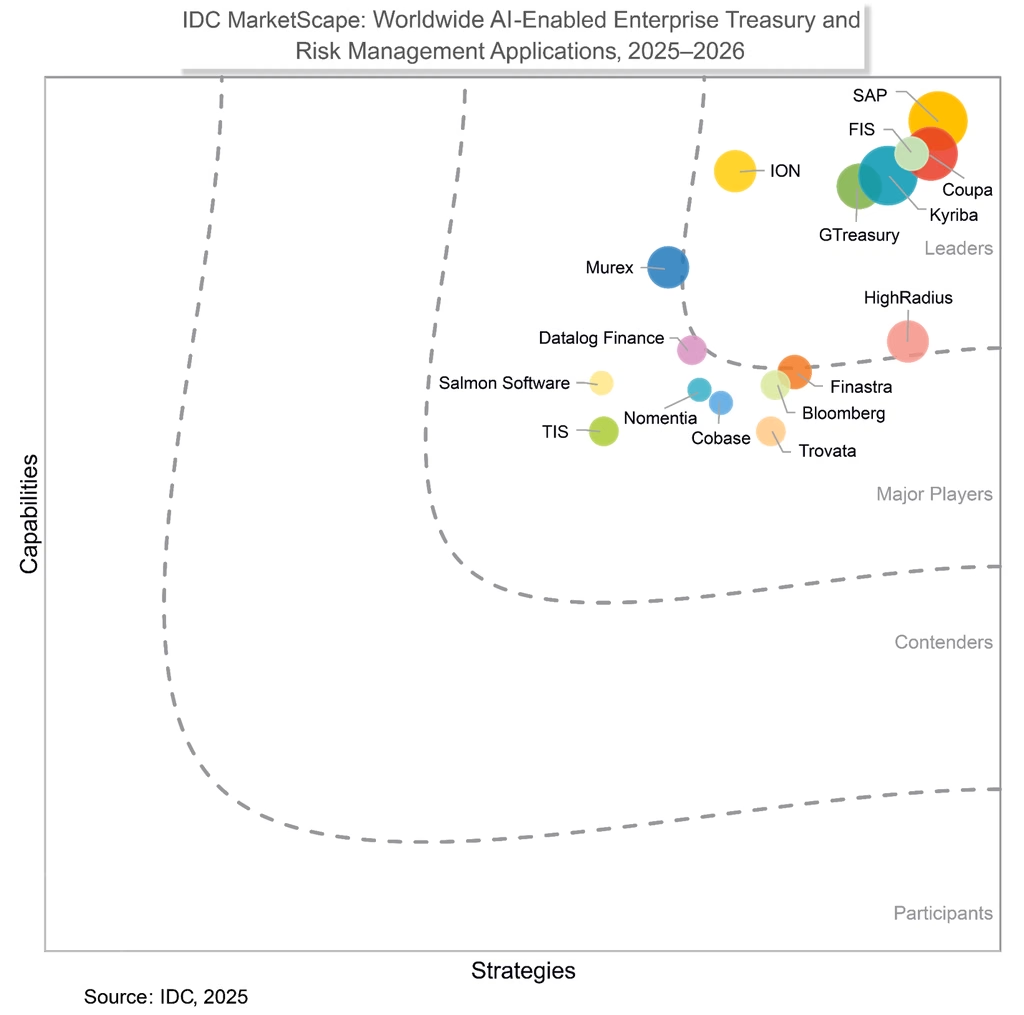
IDC MarketScape vendor analysis model is designed to provide an overview of the competitive fitness of technology and suppliers in a given market. The research methodology utilizes a rigorous scoring methodology based on both qualitative and quantitative criteria that results in a single graphical illustration of each supplier’s position within a given market. The Capabilities score measures supplier product, go-to-market and business execution in the short-term. The Strategy score measures alignment of supplier strategies with customer requirements in a 3-5 year timeframe. Supplier market share is represented by the size of the icons.
A strong ERP integration helps connect treasury teams to the financial and operational data they need to do their jobs effectively. A good integration reduces the repetitive, manual effort of reconciling information across systems. It also helps ensure treasury teams are working from a consistent view.
With over 50 years of international experience, SAP understands the complex regulatory and compliance requirements modern enterprises face.
Treasury draws on information from across the organization, including working capital, supply chain, sales, financial planning, procurement, and receivables. For treasurers managing liquidity on a global scale, stand-alone treasury management software can make it even harder to connect operations with day-to-day business activity.
Integrating treasury software with your ERP brings together data across key areas, including:
SAP was named a Leader in the IDC MarketScape: Worldwide AI-Enabled Enterprise Treasury and Risk Management Applications 2025–2026 Vendor Assessment.
The IDC MarketScape states: “SAP’s model unifies cash, payments, risk, and accounting on S/4HANA, which reduces reconciliation effort and enables real-time liquidity visibility using the One Exposure hub.”
For companies already running SAP ERP, we believe this is especially relevant. Deciding on a treasury management system is not only about adding functionality. It is also about how effectively the treasury can work with financial and operational data.
| ERP | Treasury management system | |
| Primary role | Supports broad financial and operational processes across the enterprise | Supports specialized treasury processes |
| Typical areas | Accounting, accounts payable and receivable, procurement, and enterprise operations | Cash, liquidity, payments, banking relationships, investments, and financial risk |
| Why integration matters | Holds the financial and operational data treasury relies on | Uses data to support treasury analysis and action |
The two systems serve different purposes, and each does different things well. SAP supports secure, automated payments with ERP-native reconciliation, connecting payments with the broader financial ecosystem
Learn more about treasury management.
A native SAP integration brings visibility closer to where treasury teams do the work, supporting faster, more accurate decision-making with fewer manual handoffs. With access to all enterprise data sets in real time, teams can spot trends that need attention sooner and make decisions based on reliable information.
With connected systems and clearer view of cash, treasury teams can:
Without that level of connectivity and visibility, teams spend less time acting and more time on manual efforts, such as reconciling information, gathering data, and moving between systems. Reducing manual work improves efficiency and accountability across treasury processes.
SAP treasury and working capital management capabilities support areas such as cash positioning, forecasting, liquidity planning, and bank reconciliation using connected financial data. As a consequence, treasury teams can dedicate more time to managing liquidity and risk.
AI-powered treasury uses artificial intelligence to support forecasting, financial analysis, risk identification, and decision support. AI’s effectiveness comes down to two key areas: the business context it can work with and the controls around how it is used.
Adding AI to a disconnected treasury environment isn’t an automatic win. It can create its own set of challenges. Data mapping, integrations, security requirements, and governance all need to be considered before AI can support meaningful treasury decisions.
But with a strong foundation, AI can support activities such as:
SAP incorporates AI into finance and treasury workflows, including use cases related to forecasting and decision support. AI agents are embedded within SAP applications and trained on rich, contextual data governed by embedded GRC controls. With access to business context, AI can support relevant, connected workflows across the enterprise.
In the context of SAP, the IDC MarketScape states: “Joule/Business AI scenarios are embedded in finance and treasury flows, which lets teams adopt assistance and forecasting improvements under existing governance and audit practices.
Read the IDC MarketScape: Worldwide AI-Enabled Enterprise Treasury and Risk Management Applications 2025–2026 Vendor Assessment excerpt to learn more.
Another important aspect to consider is AI governance. AI governance defines how artificial intelligence is used, monitored, and controlled. That matters when AI becomes embedded in financial processes and supports activities that operate within established finance controls, including forecasting, risk analysis, and payments.
SAP’s enterprise AI platform is ISO/IEC 42001 certified for AI governance, providing independent validation of its approach to AI management and oversight. Every AI action is governed, auditable, and traceable. Not added later.
Governance deserves equal weight when evaluating technology, alongside forecasting, automation, and usability. AI needs useful data, but it also needs to operate within the controls required for enterprise finance.
Put the power of trusted AI behind your treasury strategy – unifying liquidity and risk control while optimizing working capital across your enterprise.
For organizations already running SAP ERP, the treasury management system decision is partly an integration decision. Treasury relies on data already moving through the business, so the quality of that connection can shape how easily teams can take data, analyze it, and determine what’s next.
A long list of features may sound impressive, but the real value lies in how well treasury can work with the data, processes, and controls already embedded across the organization. Ultimately, the right treasury management solution is one that fits the way your team actually works.
Your company already runs SAP ERP–See how easily you can unify liquidity and risk control while optimizing working capital, no extra IT lift. Talk to an SAP treasury expert today.
IDC MarketScape: Worldwide AI-Enabled Enterprise Treasury and Risk Management Applications 2025–2026 Vendor Assessment, Doc #US53006225, December 2025

Find out more about SAP Taulia.
Click the link below to send us an inquiry, one of our experts will be in touch to help.

Expert Advice
In a recent session at SAP Connect, SAP Taulia’s Thomas Mehlkopf discussed how multinational businesses can turn their payables into…

Expert Advice
Accounts payable automation software enables easier management of invoicing and payment processing through a single digital platform.

Expert Advice
Over the last decade, there has been explosive growth in the range of digital working capital management solutions that are…